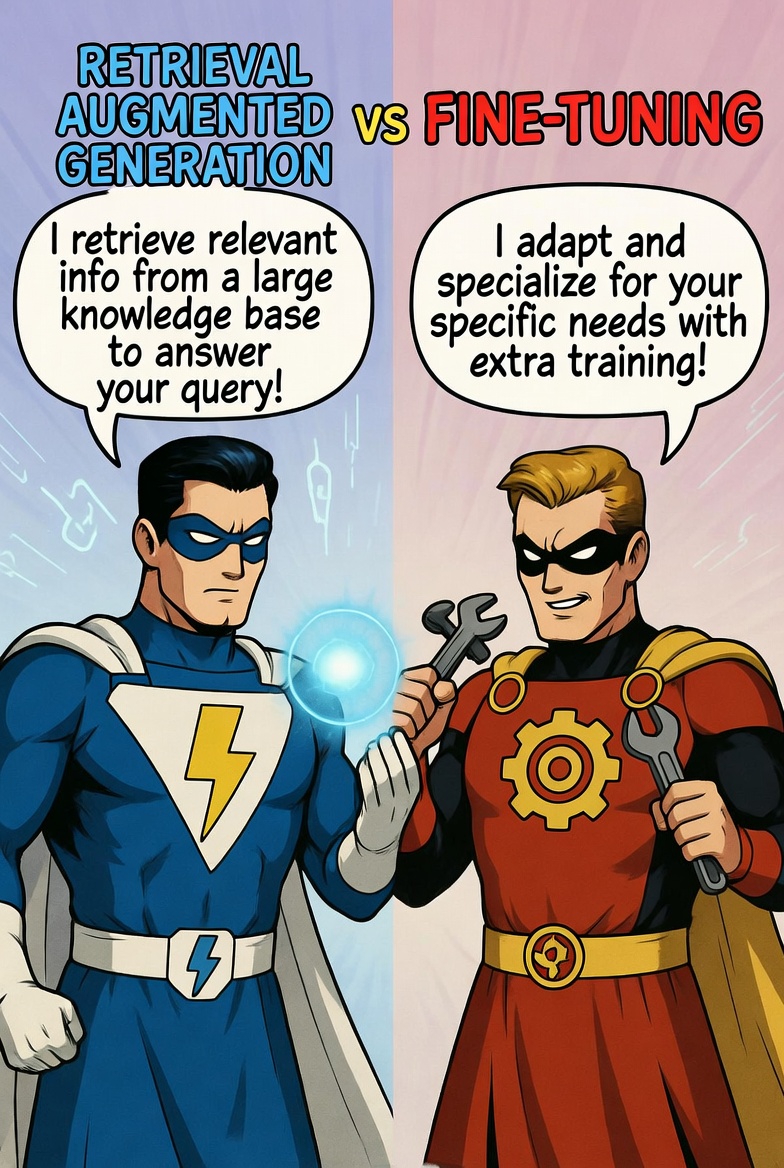
There is a question that surfaces in nearly every generative AI implementation conversation: should we use RAG or fine-tuning? It sounds like a simple either-or choice, the kind of decision that should have a clear answer. In practice, it is one of the most consequential architectural decisions an organization will make, and getting it wrong can mean months of wasted effort and budgets that spiral beyond recognition.
The confusion is understandable. Both approaches aim to make large language models more useful for specific business contexts. Both can dramatically improve the relevance and accuracy of AI outputs. And both are frequently discussed in ways that obscure their fundamental differences and appropriate applications.
I want to cut through the noise and provide a practical framework for this decision. Not because the choice is always obvious, but because understanding the tradeoffs clearly makes the path forward much clearer.
In This Post
- Understanding the Fundamental Difference
- When RAG Makes Sense
- When Fine-Tuning Makes Sense
- The Cost Equation Most People Get Wrong
- The Hybrid Approach: Best of Both Worlds
- A Decision Framework
- Implementation Realities
Understanding the Fundamental Difference
Before comparing approaches, we need to understand what each actually does.
Retrieval-Augmented Generation (RAG) connects a large language model to external knowledge sources.[1] When a user submits a query, the system first searches a knowledge base for relevant information, then provides both the question and the retrieved context to the LLM for response generation. The model itself remains unchanged; it simply receives additional context at query time.
Think of RAG as giving a knowledgeable assistant access to your company's documentation right before they answer a question. The assistant's fundamental capabilities remain the same, but they now have relevant information at their fingertips.
Fine-tuning takes a different path. It involves additional training of a pre-trained model on domain-specific data, actually adjusting the model's internal weights and parameters.[2] The result is a model that has internalized new knowledge or behaviors, embedding domain expertise into its core operation.
Fine-tuning is like sending that same assistant through specialized training. They return with new knowledge baked into their thinking, not just access to reference materials.
This distinction matters enormously for cost, performance, maintenance, and the types of problems each approach can solve.
When RAG Makes Sense
RAG has emerged as a common choice for enterprise use cases, and for good reasons. It offers distinct advantages that align well with typical business requirements.
-
Dynamic knowledge requirements. If your information changes frequently: product catalogs, policy documents, pricing information, regulatory guidance: RAG provides a significant advantage. You update the knowledge base, and the AI immediately reflects the new information. No retraining required.
-
Traceability and trust. RAG systems can cite their sources, allowing users to verify answers and trace how responses were formulated.[1] This audit trail proves invaluable in regulated industries and any context where accuracy matters.
-
Data privacy and control. With RAG, your knowledge base can remain within your infrastructure. The LLM receives context at query time but does not retain proprietary information in its weights. (Note: data still flows to the model provider during inference unless you self-host.)
-
Lower barrier to entry. Small teams can implement RAG using existing documents, wikis, and databases without hiring ML engineers or renting GPU clusters. The infrastructure requirements are more modest, and the skills needed are more commonly available.
-
Breadth of knowledge. When users might ask about a wide range of topics, RAG handles the diversity naturally. The retrieval system surfaces relevant information regardless of domain, as long as that information exists in the knowledge base.
Common RAG use cases include enterprise search and knowledge management, customer support with product documentation, legal and compliance question answering, and any application where access to current, accurate information is paramount.
When Fine-Tuning Makes Sense
Fine-tuning requires greater investment but delivers advantages that RAG cannot match in certain scenarios.[2]
-
Specialized behavior and tone. If you need the model to consistently adopt a particular communication style, follow specific formatting conventions, or exhibit domain-specific reasoning patterns, fine-tuning embeds these behaviors into the model itself. A financial services firm might fine-tune for the precise, cautious language their compliance requirements demand.
-
High-volume, repetitive tasks. When you are processing millions of queries daily on a relatively stable knowledge domain, fine-tuning can become more economical. The operational cost of RAG: particularly the "context bloat" of stuffing retrieved documents into every prompt: compounds with volume. A fine-tuned model eliminates this per-query retrieval overhead.
-
Low-latency requirements. RAG introduces retrieval latency that adds measurable overhead compared to direct model inference. For real-time applications where every millisecond matters, fine-tuning offers faster responses since all knowledge is embedded in the model rather than fetched at query time.
-
Specialized classification or extraction. When the task involves structured outputs like sentiment classification, entity extraction, or document categorization, fine-tuning often outperforms RAG. These tasks benefit from pattern recognition embedded directly into model weights.
-
Compliance and consistency. In highly regulated environments, fine-tuned models can be trained to follow specific guidelines from the ground up. This baked-in compliance can be easier to audit and verify than ensuring RAG retrieval always surfaces the right context.
Industries like healthcare diagnostics, legal document analysis, and financial modeling often find fine-tuning worthwhile for specific high-value tasks where precision and consistency justify the investment.
The Cost Equation Most People Get Wrong
There is a common misconception that RAG is the "cheap option." On the surface, it makes sense: you are using an off-the-shelf model and pointing it at your data. But the cost analysis is not that simple.
Tune for behavior. Retrieve for facts. That's the pattern that works.
RAG: Operational Costs That Scale
Every query incurs retrieval costs (embedding computation, vector database queries) and inflated token costs (the retrieved context adds to prompt size). If your base prompt is 15 tokens but you add retrieved context pushing it to 500 tokens, you pay for those additional tokens on every single query. At enterprise scale, this compounds quickly.[3]
RAG also requires ongoing infrastructure: vector database hosting, maintenance, and engineering. Knowledge base updates need processing, embedding, and indexing. These become permanent line items.
Fine-Tuning: Capital-Intensive Upfront
The primary expense is not compute but human capital: data curation, quality assurance, and evaluation design. Collecting and preparing high-quality training data is the single biggest cost, often taking far longer than teams estimate.[2] Once complete, however, inference costs are lower because you are not inflating every prompt with retrieved context.
The Crossover Point
The crossover point depends on volume and use case:
| Scenario | Recommended Approach |
|---|---|
| Internal chatbot for 500 employees, broad topics | RAG |
| Millions of daily queries on focused task | Fine-tuning |
| Frequently changing knowledge base | RAG |
| Consistent tone/format required | Fine-tuning |
| Need source citations for compliance | RAG |
| Latency-critical real-time application | Fine-tuning |
For an internal AI chatbot serving 500 employees with varied questions across a broad knowledge base, RAG almost certainly wins. The volume is low enough that per-query retrieval costs are manageable, and creating comprehensive training data for fine-tuning would be prohibitively expensive.
For a high-volume production system handling millions of queries daily on a focused task, fine-tuning may prove more economical. The one-time capital investment pays off when you eliminate per-query overhead at massive scale.
The Hybrid Approach: Best of Both Worlds
Sophisticated implementations increasingly combine both strategies rather than choosing one exclusively.[4]
The most common pattern: fine-tune for behavior, retrieve for facts. A model might be lightly fine-tuned to understand domain terminology, maintain appropriate tone, and follow specific formatting requirements. RAG then provides access to current information that grounds responses in accurate, up-to-date facts.
This hybrid approach delivers several benefits:
- The fine-tuned model understands context better, improving retrieval relevance and response quality
- RAG provides freshness and traceability that fine-tuning alone cannot offer
- The model can rely on RAG for current information, reducing the frequency of expensive retraining cycles
Another hybrid pattern: fine-tune the embedding model. The retrieval component of RAG depends on embedding models that convert text to vectors for similarity search. Fine-tuning these embedding models on domain-specific data can dramatically improve retrieval accuracy without modifying the generation model at all.[5]
The hybrid mindset extends further. Teams might fine-tune specialized models for high-volume, critical tasks while using RAG for broader question-answering. They might start with RAG to prove value quickly, then selectively fine-tune where performance data reveals clear opportunities.
A Decision Framework
Rather than prescribing one approach, work through these questions:
-
How often does your knowledge change? If information updates daily or weekly, RAG is almost certainly the right starting point. If your domain knowledge is stable for months or years, fine-tuning becomes more practical.
-
What is your query volume? Low to moderate volume favors RAG's lower startup costs. High volume: particularly millions of daily queries on focused tasks: shifts the economics toward fine-tuning.
-
How critical is response latency? Real-time applications with strict latency requirements favor fine-tuning's faster inference. Applications where a few hundred milliseconds of additional latency is acceptable can leverage RAG's retrieval step without concern.
-
Do you need traceability? If users must verify sources or you require audit trails, RAG's citation capabilities provide value that fine-tuning cannot easily replicate.
-
How specialized is the required behavior? If you need consistent tone, specific formatting, or domain-specific reasoning patterns, fine-tuning can embed these behaviors more reliably than prompt engineering within RAG.
-
What are your resources and timeline? RAG typically offers faster time-to-value with more modest infrastructure and team requirements. Fine-tuning demands specialized skills, compute resources, and longer development cycles.
-
Is this a focused task or broad capability? Narrow, well-defined tasks (classification, extraction, specific Q&A domains) suit fine-tuning. Broad knowledge access across varied topics suits RAG.
Implementation Realities
Both approaches come with challenges that rarely appear in vendor presentations.
RAG Challenges
RAG implementations face retrieval quality issues. The principle of "garbage in, garbage out" applies directly: if the retrieval system surfaces irrelevant or incorrect information, the generated response will suffer. Organizations frequently discover that what works in proof-of-concept fails at production scale with real data volumes and query patterns.
Building robust evaluation frameworks for RAG becomes a project unto itself.
Fine-Tuning Challenges
Fine-tuning brings different pain points:
- Data quality makes or breaks results: every training example matters, and inconsistent examples confuse the model
- The curation process takes longer than most teams estimate
- Infrastructure costs spiral even with parameter-efficient techniques like LoRA[6]
- Versioning becomes critical as models evolve, requiring sophisticated tracking of versions, performance characteristics, and rollback capabilities
Neither Is "Set and Forget"
Both approaches require ongoing attention. RAG knowledge bases need continuous updates and quality management. Fine-tuned models drift as the world changes around them, eventually requiring retraining. Neither is "set and forget."
Looking Forward
The distinction between RAG and fine-tuning continues to blur. Models with built-in retrieval capabilities are emerging. Fine-tuning increasingly incorporates retrieval mechanisms. Agentic AI systems combine both approaches dynamically based on query characteristics.
Organizations that succeed will develop capabilities in both approaches, starting with whichever addresses their most pressing needs while building toward more sophisticated hybrid implementations. The question is not which approach wins, but which approach fits your current situation, and how you evolve from there.
A Closing Thought
The RAG versus fine-tuning decision is often framed as a technical choice, a matter of architecture and algorithms. In practice, it is equally a business choice: a question of costs, timelines, resources, and strategic priorities.
There are some things we can do to navigate this decision well:
- Start with a clear understanding of requirements: particularly around knowledge freshness, query volume, and latency tolerance
- Resist the urge to default to either approach simply because it seems simpler or trendier
- Pilot both approaches on representative problems before committing significant resources
- Design systems with flexibility, recognizing that the optimal approach may evolve as you learn more about actual usage patterns
The organizations that get this right are not those who find the perfect answer on day one. They are those who understand the tradeoffs clearly, make informed initial choices, and adapt as they learn. In a field moving as quickly as generative AI, that adaptive capability may be the most valuable technical asset of all.
This is the eighth in our January series on data and AI strategy for 2026. Subscribe to receive the full series as it publishes throughout the month.
Sources
-
Lewis, P., et al. "Retrieval-Augmented Generation for Knowledge-Intensive NLP Tasks." NeurIPS, 2020. The foundational paper introducing RAG architecture. arxiv.org
-
OpenAI. "Fine-tuning Guide." Platform documentation on when and how to fine-tune models. platform.openai.com
-
OpenAI. "Pricing." Token-based pricing models and context window costs. openai.com
-
Gao, Y., et al. "Retrieval-Augmented Generation for Large Language Models: A Survey." 2023. Comprehensive survey covering RAG architectures and hybrid approaches. arxiv.org
-
Reimers, N. & Gurevych, I. "Sentence-BERT: Sentence Embeddings using Siamese BERT-Networks." EMNLP, 2019. Foundation for domain-specific embedding fine-tuning. arxiv.org
-
Hu, E. J., et al. "LoRA: Low-Rank Adaptation of Large Language Models." ICLR, 2022. Parameter-efficient fine-tuning technique. arxiv.org